There's a particular kind of morning that only happens in an airpark. The weather window opens, you walk out the back of the house, roll the door up, and you're wheels-up before most people have finished their coffee. No drive to the field. No tie-down fees. No coordinating with an FBO.
That's the pitch, and for the right buyer it's an easy one. What's harder — and what almost nothing written about airpark living addresses — is the transaction itself. Buying a hangar home is not buying a house with an unusual garage. The runway has an owner. Access may be contractual rather than automatic. The hangar may or may not count toward the appraised value your lender is willing to underwrite. Get those things wrong and a clean purchase turns into a four-month problem.
This guide covers both halves: which Colorado communities actually qualify as residential airparks, and what matters when you buy or sell in one.
What Actually Counts as an Airpark
Worth clearing up first, because the term gets applied loosely and it costs buyers time.
A residential airpark is a subdivision where the home sites themselves have taxiway access to a runway. You taxi from your own property. That's the defining feature, and it's narrower than it sounds. A public airport with rental hangars isn't an airpark. Neither is a neighborhood that happens to sit near a field, or a subdivision built on top of an airport that closed.
Colorado has a few well-known examples of the near-miss. Platte Valley in Hudson is a privately owned public-use field with ground-leased hangars — no residential lots. Fort Collins Downtown Airport closed in 2006, and the "Airpark" neighborhood that carries its street names is now ordinary housing with no runway. Spanish Peaks at Walsenburg is a county-owned public airport with rural land around it, not a platted airpark.
Four communities in Colorado genuinely qualify, plus Erie.
Erie Air Park
Erie is the one that matters most to Front Range buyers, and it's where we've done the most business.
Homes sit on taxiways feeding Erie Municipal Airport, which puts residents roughly twenty-five minutes from Boulder and a manageable drive into north Denver. That combination is genuinely rare. Look at the rest of Colorado's airparks and you'll see why — they're in Elbert County, Peyton, Crawford, and Westcliffe. Good communities, but they ask you to reorganize your life around the airfield. Erie lets you keep a plane in the backyard and still get to an office in Boulder.
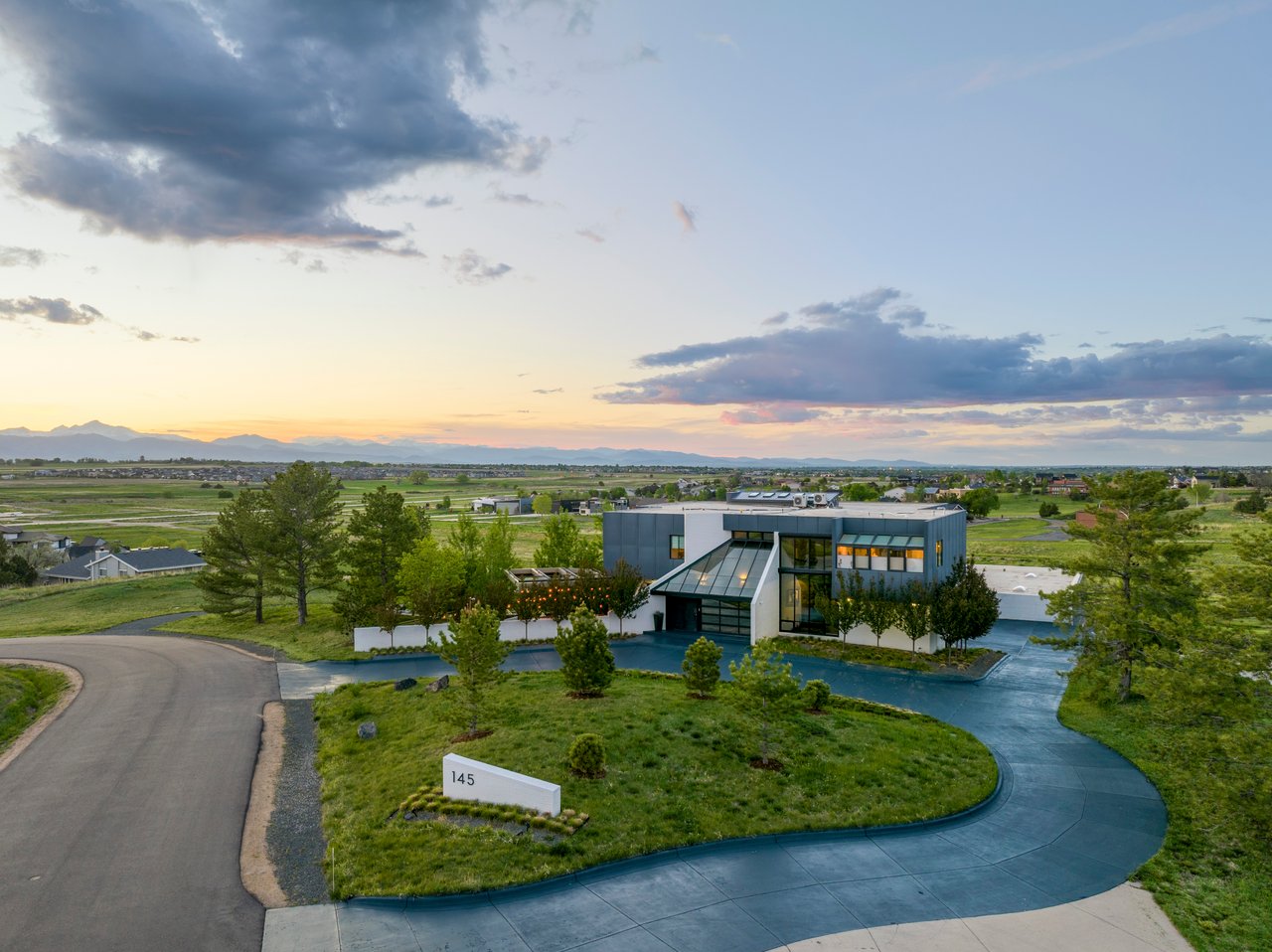
We listed and sold 145 Piper Drive here — a hangar estate deep enough to hold five vehicles when the plane is out, with floor-to-ceiling mountain-facing glass, a saltwater lap pool, and an outdoor kitchen. It's a useful reference point for what the top of this market looks like and what it trades for. You can see it among our recent sales.
Erie is also worth watching for reasons that have nothing to do with aviation. The town has been among the faster-growing municipalities in the north metro and its zoning has been comparatively accommodating — we covered the accessory dwelling angle in our look at ADU potential in Boulder County. For buyers weighing Erie against Boulder proper, our comparison of Boulder versus the surrounding towns lays out the tradeoffs.
Kelly Air Park
Kelly Air Park (CO15) sits near Elizabeth in Elbert County, about thirty-five to forty minutes from the Denver Tech Center and roughly fifty to Colorado Springs. It's the closest thing Colorado has to a purpose-built luxury fly-in community.
The main runway is 3,800 feet of asphalt, with a 1,700-foot gravel and turf crosswind strip. Both are HOA-owned and HOA-maintained, which is the cleanest ownership structure you'll find — homeowners collectively own the airfield outright rather than negotiating access with anyone. There are around fifty-six lots, most of them two to ten acres and better, and the subdivision is fully platted. Vacant parcels come up rarely.
Improved properties generally trade between $1.1 million and $2.2 million and up. These are custom hangar homes on multi-acre land, and the price reflects both.
If you want the airpark lifestyle without leaving the Denver orbit entirely, Kelly is the serious alternative to Erie.
Meadow Lake Estates
Meadow Lake (FLY) in Peyton is the largest general aviation operation on this list, and the runway situation reflects that: 6,000 feet of asphalt on the main, plus two turf strips at 2,084 and 2,700 feet. That's real capability. Longer runway, more surface options, room for aircraft that would be marginal elsewhere.
The airport is owned by the Meadow Lake Airport Association and is public-use, with residents reaching it through a through-the-fence arrangement. There are eighty-plus residential and hangar parcels and the community is mostly built out, though vacant lots resell from time to time.
Prices run roughly $650,000 to $1.2 million depending on hangar size and finished square footage — noticeably more accessible than Kelly. Colorado Springs is about twenty minutes out; Denver is a little over an hour.
Crawford Airpark
Crawford (99V) is on the Western Slope, about forty-five minutes from Montrose and an hour and fifteen from Grand Junction. One asphalt runway at 4,900 feet, owned by the Town of Crawford, with dedicated residential through-the-fence easements for the airpark lots.
There are roughly thirty to forty lots at two to four acres, and several remain undeveloped — one of the few places on this list where building from scratch is still a live option. Improved properties run about $450,000 to $850,000.
The cost basis here is a fraction of the Front Range, and the flying is Western Slope flying. Different proposition entirely, and for some buyers that's the whole appeal.
Silver-West Estates
Silver-West (C08) sits in the Wet Mountain Valley outside Westcliffe, about an hour from Pueblo and an hour forty-five from Colorado Springs. The runway is the standout: 6,990 feet of asphalt at Custer County Airport, publicly owned, with through-the-fence access for the estates.
Nearly 7,000 feet at that elevation is meaningful performance margin. Density altitude is the constraint that shapes Colorado flying, and Silver-West has more runway than almost anything comparable.
Around sixty lots, five acres and up, with multiple undeveloped parcels still available. Improved properties run roughly $550,000 to $950,000; unimproved five-acre lots trade around $50,000 to $75,000.
Who Owns the Runway
That's the single most important question to answer before writing an offer, and it's almost never in the listing.
The four communities above cover all three of the common arrangements. Kelly's HOA owns its airfield outright. Meadow Lake and Silver-West use through-the-fence access to publicly owned fields. Crawford's runway belongs to the town, with easements running to the residential lots.
The practical difference shows up years later. An HOA-owned runway means predictable but real assessments — resurfacing is a five- or six-figure event spread across a small number of households, and you'll pay your share. Through-the-fence access means your ability to taxi from your own driveway rests on an agreement with an airport sponsor, and those agreements have terms, renewal dates, and in some cases FAA involvement. Easements are only as good as the language in them.
None of these is inherently better. But you should know which one you're buying, and you should read the governing documents rather than the brochure.
What the Hangar Does to the Appraisal
Here's where airpark purchases most often go sideways.
A hangar is an expensive structure with a very narrow buyer pool. Appraisers value property by finding comparable sales, and in a market where a given airpark might see two or three transactions a year, the comparable set can be thin enough that the appraiser reaches outside the community entirely. At that point the hangar starts getting valued like an oversized outbuilding, and the number comes in well under contract.
That gap is the most common reason these deals stall. The defenses are the ones that work in any thin market: a lender who has financed airpark property before, an appraiser with the relevant background, and a listing package that hands over the comparable data rather than hoping it gets found. We take the same approach with other hard-to-comp properties — the problem is structurally identical to pricing homes with premium mountain views, where the feature driving the price is the feature hardest to support with comps.
Insurance deserves a look too. A hangar with an aircraft in it isn't always covered the way a homeowner assumes, and carriers treat attached and detached structures differently.
Restrictions Worth Reading First
Airpark covenants run longer than typical HOA documents, because they govern an airfield as well as a neighborhood. Expect language on aircraft size and weight limits, engine run-up locations and hours, what you can store in the hangar, and whether commercial aviation activity is permitted from your property.
That last one matters more than buyers expect. If you have any thought of doing maintenance work, flight instruction, or charter operations out of your hangar, confirm it's allowed before closing. Plenty of airparks prohibit it, and the prohibition is enforceable.
The noise question, meanwhile, mostly solves itself. Everyone who lives there chose to.
Selling an Airpark Home
Selling into a niche market is a marketing problem before it's a pricing problem. Your buyer exists, but there may be a few dozen of them in the Mountain West, and none of them are browsing Zillow's Elbert County results.
That means reaching pilots where pilots actually are — aviation listing platforms, type clubs and owner associations, EAA chapters, and the brokers who've handled these properties before. It also means a listing that speaks the language: runway length and surface, hangar door dimensions and clearance, taxiway access, fuel on the field, and the access arrangement stated plainly. A listing that details the kitchen and gives the hangar one line is leaving money on the table.
Timing matters as well. Buyers look when they're flying, so this market has a more pronounced seasonal shape than the market generally. Our guidance on selling a luxury home in Boulder applies here, and the principles behind horse property sales — where land and improvements carry as much weight as the house — translate almost directly. For a broader read on how unusual properties perform in this market, our monolithic dome home guide covers similar ground, and our Boulder County market statistics give the current baseline.
Talk to Someone Who's Closed One
Karen Bernardi has spent 35 years in the Boulder County market and leads The Bernardi Group, the #1 Coldwell Banker Realty team in Colorado and #9 nationally. She belongs to the Coldwell Banker Society of Excellence, an honor extended to fewer than 1% of agents worldwide. We've sold across Boulder, Jefferson, Larimer, Weld, Broomfield, and Adams counties, including hangar property at Erie Air Park — and you can see how that record looks in the MLS data.
For sellers, that means full staging, professional photography and video, and marketing built for a buyer pool that doesn't shop the way conventional buyers do. For buyers, it includes our internal bridge loan program — genuinely useful in a market this thin, where the right property may come up once and you need to move without waiting on your current home to sell.
Call us at 303.402.6000 or reach out here to start the conversation.